
Last Updated on October 14, 2026 by Amit Kakkar
- Brave is the best AI search API for most live agents: It posted the top Agent Score of 14.89 and the lowest latency at 669 ms in AIMultiple’s 100-query benchmark, and its lead over Tavily was the only statistically meaningful gap.
- Seven AI search APIs cover most agent jobs: Brave for fast grounding, Firecrawl for full pages, Exa for semantic research, Parallel for low-cost research, Tavily for LangChain prototypes, Perplexity for cited answers and Linkup for UK and EU compliance.
- Most AI search APIs cost $5 to $8 per 1,000 searches: Parallel Turbo is cheapest at $1, while built-in model search costs more, with Claude at $10 and Gemini 3 at $14 per 1,000 after 5,000 free monthly queries.
- Query fan-out multiplies search costs: One developer sent fewer than 500 prompts that triggered over 5,000 search requests, and both built-in and standalone tools bill per search, so set spending caps before launch.
- Bing’s API has closed and Google’s retires on January 1, 2027: Microsoft ended the Bing Search APIs on August 11, 2025, and Nebius agreed to buy Tavily in February 2026, so keep your search layer behind one swappable interface.
- AI search APIs decide which pages agents can cite: Claude’s web search draws on Brave’s index while Google’s AI features use Google’s own, so SaaS visibility now depends on being indexed in both, not only on Google rankings.
The best AI search APIs for agents and LLM apps in 2026 are Brave, Exa, Tavily, and Parallel. Firecrawl, Perplexity, and Linkup complete the top seven. Brave has the top benchmark score and the fastest speed. Exa suits semantic research, and Tavily suits LangChain prototypes. Parallel Turbo is the cheapest at $1 per 1,000 searches.
How Did We Evaluate These AI Search APIs?
We ranked each API using independent benchmark data, verified 2026 pricing, and fit for common agent jobs. We checked every price in September 2026 against vendor documentation or independent pricing trackers. For quality and speed, we used AIMultiple’s benchmark instead of vendor-published claims. Any vendor-only figure is clearly labeled.
- Quality : AIMultiple’s agentic search benchmark scored 4,000 results from 100 real AI and LLM queries.
- Speed : Average response time per search, from the same benchmark.
- Cost : List price per 1,000 searches at 10 results.
- Risk : Ownership changes, SOC 2 reports, zero data retention, and GDPR readiness.
- Limits to note : The benchmark covered AI and LLM topics only. It reflects a December 2025 snapshot.
What Is an AI Search API?
An AI search API is a web service that lets your AI agent or LLM app query the live web. It returns ranked links, clean text excerpts, or cited answers in a machine-ready format. Your model then works from current facts instead of stale training data.
| Type | What you get back | Examples | Best for |
| AI-native search API | Ranked URLs plus LLM-ready excerpts or full text | Exa, Tavily, Parallel, Linkup, Firecrawl | Agents, RAG, research |
| Independent index API | Links, snippets, and LLM context from its own index | Brave Search API | Fast, broad grounding |
| SERP API | Google result metadata: titles, snippets, URLs | Serper, SerpAPI | Rank tracking, SEO tools |
| Built-in model search | A cited answer inside the model call | Claude web search, Gemini grounding | Simple setups |
Why Does Your AI Agent Need a Search API in 2026?
Your agent needs a search API because every LLM stops learning at its training cutoff. Prices, product docs, regulations, and news keep changing after that date. A search API gives your agent current, citable facts in one tool call. That reduces outdated answers and unsupported claims.
The old defaults are also gone. Microsoft retired the Bing Search APIs on August 11, 2025. It now points customers to Grounding with Bing Search in Azure AI Agents. Google closed its Custom Search JSON API to new customers. Existing users must move to an alternative by January 1, 2027.
Agents also search more than once per question. Google calls this query fan-out: the model runs several related queries at the same time. Your cost and latency grow with every one of those searches.
How Do the Best AI Search APIs for Agents and LLM Apps Compare?
Brave, Firecrawl, Exa, and Parallel Pro form the top quality tier with similar scores. Brave is the fastest at 669 ms. Parallel Turbo is the cheapest AI-native option at $1 per 1,000 searches. Tavily trails slightly on quality but includes 1,000 free credits each month.
| API | Best for | Price per 1,000 searches | Free allowance | Agent Score / latency |
| Brave Search API | Fast, independent grounding | $5 | $5 monthly credit (~1,000 searches) | 14.89 / 669 ms |
| Firecrawl | Search plus full-page content | ~$6.40 on entry plan (2 credits per search) | 1,000 credits monthly | 14.58 / 1,335 ms |
| Exa | Meaning-based discovery | $7 (up to 10 results) | $20 signup + $10 monthly credits | 14.39 / ~1.2 s |
| Parallel | Low-cost grounding, deep research | $1 (Turbo) to $5 | $5 monthly credit | 14.21 Pro (13.6 s) / 13.50 Base (~2.9 s) |
| Tavily | LangChain agents, prototypes | $8 pay-as-you-go; $5–$7.50 on plans | 1,000 credits monthly | 13.67 / 998 ms |
| Perplexity Search API | Raw results; Sonar for cited answers | $5 | Pay as you go | 12.96 / 11+ s |
| Linkup | UK and EU compliance needs | ~$5 standard | $20 monthly top-up (eligible accounts) | Not tested |
Key finding : Brave’s lead over Tavily was the only statistically meaningful gap in the benchmark. When quality ties, choose on latency and cost.
Which AI Search API Should You Choose for Your Use Case?
Choose the API that matches your agent’s main job. Brave fits fast, general agents. Exa fits semantic research. Tavily fits LangChain prototypes. Parallel fits low-cost grounding and deep research. Firecrawl fits agents that need full pages. Perplexity fits async cited answers. Linkup fits UK and EU compliance needs.
1. Brave Search API
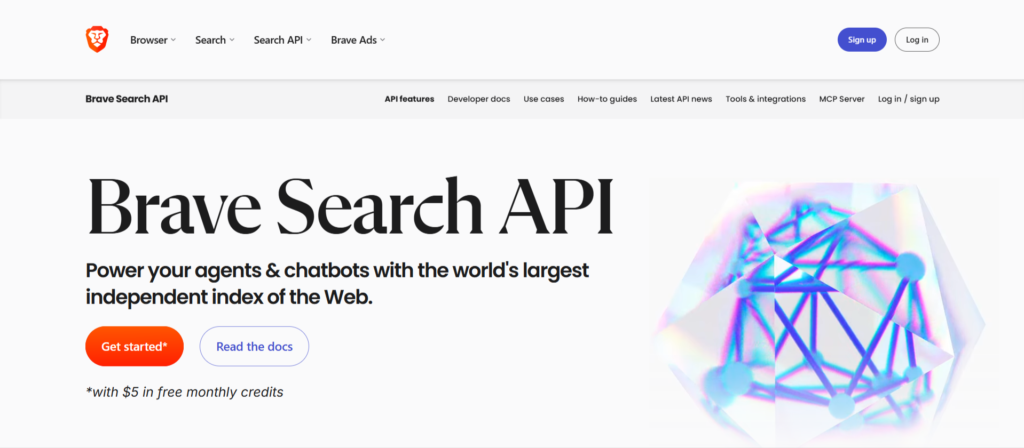
Brave Search API is the best all-round pick because it pairs top benchmark quality with the lowest latency. Results come from Brave’s own index, which Brave says holds over 40 billion pages. The LLM Context endpoint returns grounding data for models. The Answers plan returns cited, streamed answers through an OpenAI-compatible interface.
Type : Independent web index with Web, News, Image, Video, Place, LLM Context, and Answers endpoints.
Access and limits : You authenticate with an X-Subscription-Token header. The Search plan allows 50 queries per second, and Answers allows 2.
Benchmark : Highest Agent Score (14.89) and lowest latency (669 ms) in AIMultiple’s test.
Best for : Live chatbots, support agents, and RAG pipelines that need fast, broad web grounding.
Pros
- Fastest top-tier API, so multi-step agents stay responsive.
- Goggles let you boost, downrank, or filter results by URL pattern.
- Enterprise plans include full zero data retention.
Cons
- Free credits require a card on file, and billing starts once they run out.
- Storing results to train models requires a plan with storage rights.
Pricing : Search costs $5 per 1,000 requests, with $5 in free monthly credits. Answers costs $4 per 1,000 requests plus $5 per million tokens.
2. Firecrawl
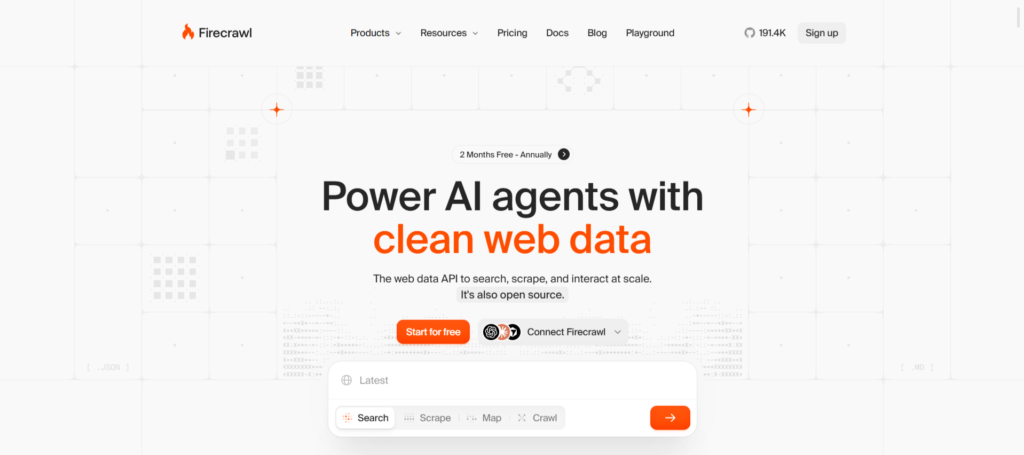
Firecrawl beats a standard search API when your agent needs page content, not just links. Search returns ranked, query-relevant excerpts by default. You can attach full-page content in the same call and skip a separate scraper. Filters cover news, images, GitHub, research papers, and PDFs, plus time and country.
Type : Web data API with Search, Scrape, Parse, Crawl, Map, and Interact endpoints.
Access and limits : Use REST, an MCP server, a CLI, or Python and Node SDKs. The core is open source, and search supports zero data retention.
Benchmark : Second overall (14.58) at 1,335 ms, with the highest mean relevance score and the best deep content retrieval.
Best for : Agents that must read full pages, PDFs, or developer docs before answering.
Pros
- Search and extraction happen in one call.
- Default excerpts keep token use low.
- Interact handles pagination, forms, and logged-in sessions.
Cons
- Slower than Brave for simple lookups.
- Search, scrape, and parse use different credit rates, so model costs carefully.
Pricing : You get 1,000 free credits monthly. Paid plans start at $19 per month, or $16 billed annually, for 5,000 credits. A search uses 2 credits, and each scraped page uses 1.
3. Exa
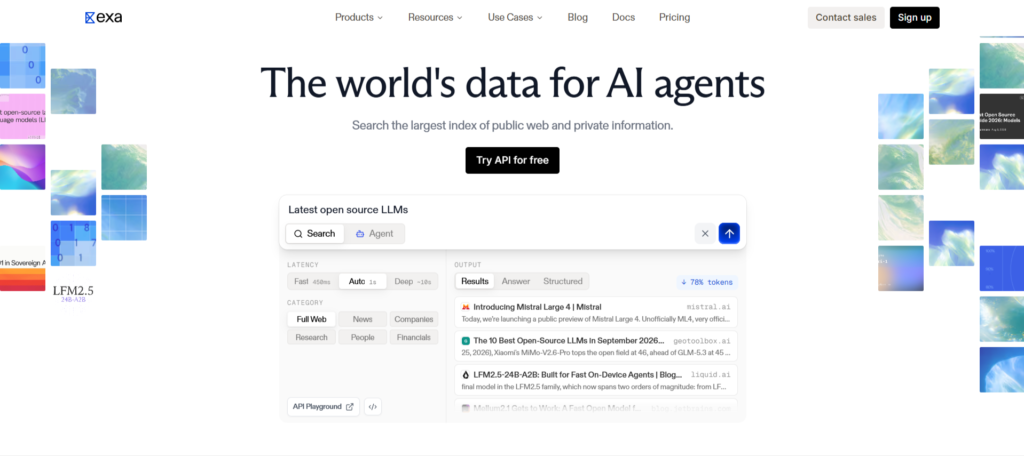
Use Exa when keyword search misses the pages your agent needs. Exa ranks pages by meaning, so it handles research questions and “find similar” tasks well. Search types run from instant to deep-reasoning, so you can trade speed for depth per query. The Contents endpoint adds page text, highlights, or summaries.
Type : Neural web index with Search, Contents, Deep Search, research, and monitoring endpoints.
Access and limits : Latency is configurable from about 180 ms to 1 second. Enterprise plans unlock up to 1,000 results per search, custom indexes, and zero data retention.
Benchmark : Third overall (14.39) at about 1.2 seconds, with the top quality score on technical documentation queries.
Best for : Research agents, lead discovery, and RAG apps that need conceptually relevant sources.
Pros
- Meaning-based ranking finds pages that keyword engines miss.
- Token-efficient highlights cut the text your model reads.
- Startup and education grants offer $1,000 in credits.
Cons
- Each result above 10 adds $1 per 1,000 requests.
- Separate meters for depth, results, and content types make forecasting harder.
Pricing : Exa’s pricing page lists Search at $7 per 1,000 requests with up to 10 results. Contents cost $1 per 1,000 pages per content type, and Deep Search runs $12 to $15 per 1,000. New accounts get $20 in credits, plus $10 monthly.
4. Parallel
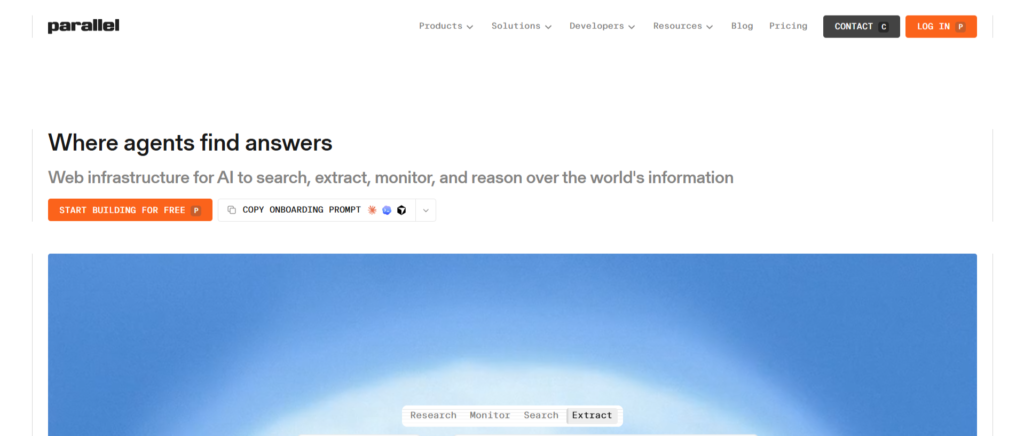
Yes. Parallel’s Turbo mode is the cheapest AI-native option at $1 per 1,000 requests. You send a plain-language objective, with optional keyword queries, and get ranked URLs with excerpts. You set excerpt size per result and per response, which keeps context windows lean. The Task API handles research that needs more than one search.
Type : Proprietary web index with Search, Task, FindAll, Enrichment, and Monitor APIs.
Access and limits : Turbo responds in about 200 ms, Basic in about 1 second, and Advanced in about 3 seconds. Deeper research runs can take minutes.
Benchmark : Parallel Pro scored 14.21, inside the top tier, but averaged 13.6 seconds. Parallel Base scored 13.50 at about 2.9 seconds.
Best for : High-volume grounding on a budget, plus background research that needs sourced evidence.
Pros
- Turbo costs one-fifth of the common $5 rate.
- Results include provenance for evidence-backed answers.
- SOC 2 Type II certified.
Cons
- Pro-tier latency suits background jobs, not live chat.
- Each result beyond 10 costs $1 per 1,000 results.
Pricing : Turbo costs $1 per 1,000 requests. Basic and Advanced cost $5 per 1,000. Parallel adds $5 in free credits every month.
5. Tavily
LangChain and LlamaIndex teams choose Tavily because it returns clean, citation-ready results with native framework support. Tavily pulls from multiple sources in real time rather than one proprietary index. Each result carries a relevance score, so your agent can drop weak sources early. You can filter by time range and domain, and set chunks per source.
Type : AI search API with Search, Extract, Map, Crawl, and Research endpoints.
Access and limits : Development keys allow 100 requests per minute, and production keys allow 1,000. Credits reset on the first of each month.
Ownership : Nebius agreed to acquire Tavily on February 10, 2026. Co-founder Roman Chernin said the deal “brings the search layer directly into our stack.”
Benchmark : Fifth overall (13.67) at 998 ms. Brave outscored it by a statistically meaningful margin.
Best for : LangChain prototypes and RAG pipelines that want search and extraction from one vendor.
Pros
- 1,000 free credits monthly, with no card required.
- SOC 2 certified, with zero data retention.
- Extract, Map, and Crawl cover follow-up page reading.
Cons
- Quality trailed the top tier in the independent benchmark.
- The ownership change may reshape pricing and roadmap.
Pricing : Pay-as-you-go costs $0.008 per credit. Monthly plans start at $30 for 4,000 credits and reach $0.005 per credit at 100,000. Basic search uses 1 credit, and advanced uses 2.
6. Perplexity
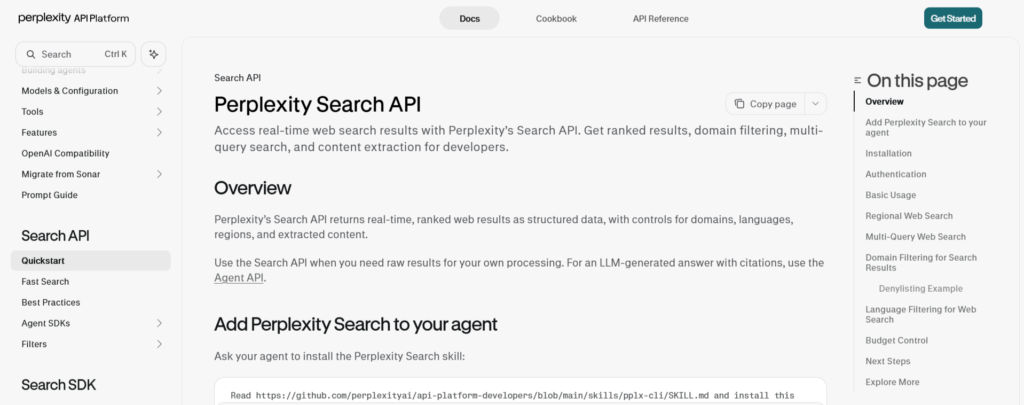
Use the Perplexity Search API for raw ranked results, and Sonar for a finished, cited answer. The Search API returns titles, URLs, snippets, and publication dates. You can request 1 to 20 results and cap extracted text per page. Sonar uses an OpenAI-compatible interface, so switching from the OpenAI SDK takes one line.
Type : Search API plus Sonar grounded-answer models, an Agent API, and an Embeddings API.
Access and limits : Rate limits scale with usage tiers tied to your total spend.
Benchmark : Seventh overall (12.96), with over 11 seconds average latency.
Best for : Async summaries, research digests, and apps that want a cited answer in one call.
Pros
- Flat Search API pricing with no token charges.
- Sonar handles search and synthesis in one call.
- One vendor covers search, answers, and embeddings.
Cons
- Each Search API call caps at 20 results.
- Sonar bills tokens plus a request fee, so costs stack at volume.
Pricing : The Search API costs $5 per 1,000 requests. Sonar costs $1 per million input and output tokens, plus $5 to $12 per 1,000 requests by search context size.
7. Linkup
UK and EU teams should consider Linkup because it is a European vendor with strong compliance terms. The Paris-based company stores web information as small facts, each with a source and timestamp. You can include up to 100 domains, exclude others, and bound results by date. The Tasks endpoint batches mixed calls into one asynchronous job.
Type : AI-native web index with Search (Fast, Standard, Deep), Fetch, Research, and Tasks endpoints.
Access and limits : Linkup’s docs call standard search sub-second, but its pricing page lists 1 to 3 seconds. Measure it on your own queries.
Benchmark : Not in AIMultiple’s test. Linkup reports a 92% F-score on Verified SimpleQA and publishes its evaluation code.
Best for : Teams with UK GDPR or EU GDPR requirements, and enterprises that need private deployments.
Pros
- SOC 2 Type II and zero data retention on every plan.
- Enterprise options include private environments and IP whitelisting.
- Customers include KPMG and AI company Artisan.
Cons
- No independent benchmark results yet.
- A younger, seed-stage vendor after its $10 million round in February 2026.
Pricing : Search costs $0.005 to $0.006 per request, or $5 to $6 per 1,000. Research runs $0.25 to $2.50 per task. Eligible accounts get a $20 free top-up each month.
Should You Use Built-In LLM Search Instead of a Search API?
Use built-in LLM search when you want the fastest setup and one vendor. Choose a standalone search API when you need control over sources, cost, and vendor choice. Built-in search usually costs more: Claude charges $10 and Gemini 3 charges $14 per 1,000 searches, plus tokens.
| Option | Price | Billing unit |
| Claude web search tool | $10 per 1,000 searches, plus tokens | Per search performed |
| Gemini 3 grounding with Google Search | 5,000 free per month, then $14 per 1,000 | Per search query |
| Standalone API (Brave, Perplexity Search) | $5 per 1,000 | Per request |
Watch the billing unit. Both options bill per search, not per prompt. One developer on Google’s forum sent fewer than 500 prompts that produced over 5,000 search requests. That is query fan-out in action, so set spending caps before launch.
How Do You Choose the Right AI Search API in 7 Steps?
Match the API to your agent’s job, latency budget, total cost, and compliance needs. Then test your top picks on your own queries before you commit. These seven steps take you from a long list to a confident decision.
- Define the job : Live chat, background research, and monitoring each need different search depth.
- Pick the output : Decide between snippets, excerpts, full pages, or finished answers.
- Set a latency budget : Five search calls take about 3 seconds on Brave and 68 seconds on Parallel Pro.
- Model the true cost : Add extra results, content fees, fan-out searches, and the tokens your model reads.
- Check compliance : Request SOC 2 reports and zero data retention terms. UK and EU teams should also confirm a GDPR-ready DPA.
- Run a bake-off : Test 50 to 100 of your real queries on your top three picks.
- Plan an exit : Put search behind one interface so you can switch vendors quickly.
Benchmarks shape your shortlist. Your own queries decide the winner.
What Changed in the AI Search API Market in 2026?
The AI search API market consolidated and changed its pricing within a year. Microsoft and Google retired or closed their developer search APIs. Brave ended its free plan, and Nebius agreed to buy Tavily. Plan for vendor risk and keep your search layer easy to swap.
| Date | Change | What it means for you |
| Aug 11, 2025 | Microsoft retired the Bing Search APIs | Bing access now runs through Azure AI Agents |
| Feb 2026 | Brave replaced its free plan with $5 monthly credits | Free testing now needs a card |
| Feb 10, 2026 | Nebius agreed to acquire Tavily | Watch Tavily’s roadmap and pricing |
| Feb 2026 | Linkup raised a $10M seed round | More choice for UK and EU buyers |
| Jan 1, 2027 | Google Custom Search JSON API retires | Migrate existing workloads now |
How Do AI Search APIs Affect Your SEO and AI Visibility?
AI search APIs decide which pages AI tools can find, read, and cite. Claude’s web search draws on Brave’s index. Google’s AI features draw on Google’s own Search index. So your visibility now depends on several indexes, not only on Google rankings.
Anthropic added Brave Search to its subprocessor list in March 2025, and Brave was still listed in July 2026. Google keeps its advice simple. Its guide to generative AI features says optimizing for AI search “is optimizing for the search experience, and thus still SEO.”
Use this checklist :
- Get indexed everywhere : Confirm your key pages appear in both Google and Brave Search. Google requires pages to be indexed and eligible to show a snippet.
- Lead with the answer : Agents read excerpts, so answer each question in your opening lines.
- Publish non-commodity content : Google favors unique, first-hand insight over recycled summaries. Start with comparison pages that rank in AEO search results.
- Build topical depth : See the 15 content types that get cited by LLMs.
- Earn genuine mentions : Google says inauthentic mentions add little value. Compare brand mentions vs backlinks for AI search visibility.
- Measure results : Use Search Console’s Generative AI performance report alongside AI search visibility tools that track LLM mentions.
If your product still misses AI answers, read why your SaaS may not show up in ChatGPT. Then run a full audit of your SaaS brand in generative search.
What Is the Final Verdict?
Brave Search API is the best default for most live agents in 2026. Add Exa for semantic research or Firecrawl for full pages. Use Parallel Turbo when cost matters most. UK and EU teams with strict compliance needs should also test Linkup before deciding.
Want your SaaS cited in the answers these agents build?
Book a free AI visibility audit with Growthner. We test the prompts your buyers ask across ChatGPT, Claude, Gemini, and Perplexity.
FAQs
1. What is the best AI search API for agents in 2026?
Brave Search API is the best all-round choice for most live agents. It posted the top score and the fastest speed in AIMultiple’s 100-query benchmark. Choose Exa for semantic research, Tavily for LangChain prototypes, and Parallel Turbo for low-cost, high-volume grounding.
2. Which AI search API is the cheapest?
Parallel’s Turbo mode is the cheapest AI-native option at $1 per 1,000 requests. Serper drops to $0.30 per 1,000 on its largest pack, but it returns Google snippets only. Most other AI search APIs cost $5 to $8 per 1,000 searches.
3. Is there a free AI search API?
Yes, several AI search APIs include free allowances. Tavily and Firecrawl each give 1,000 credits a month. Brave gives $5 in monthly credits, which covers about 1,000 searches. Exa offers signup and monthly credits, and Serper gives 2,500 free queries once.
4. What is the difference between a SERP API and an AI search API?
A SERP API returns search engine result metadata: titles, URLs, and short snippets. An AI search API returns LLM-ready content, such as matched excerpts, full page text, or cited answers. SERP APIs suit rank tracking, while AI search APIs suit agents and RAG.
5. What replaced the Bing Search API?
Microsoft retired the Bing Search APIs on August 11, 2025. It now directs customers to Grounding with Bing Search inside Azure AI Agents. Many developers chose independent options instead, such as Brave Search API, Exa, Tavily, or Parallel, for more vendor control.
6. Do you need llms.txt or schema to appear in Google’s AI Overviews?
No. Google’s July 2026 guidance says Google Search ignores llms.txt files and needs no special AI markup. Structured data is optional for AI features but still helps with rich results. Your pages must be indexed, crawlable, and eligible to show a snippet.
About the Author


