
Last Updated on September 30, 2026 by vikas chaudhary
- Five AI search visibility tools lead for tracking brand mentions in LLMs: Semrush AI Visibility Toolkit suits SEO teams, Ahrefs Brand Radar existing Ahrefs users, Profound enterprise brands, Peec AI lean and multi-country teams, and Otterly.AI tight budgets.
- Entry prices run from $29 to $199 per month: Otterly.AI starts at $29 for 15 prompts, Peec AI at $95, Semrush and Profound at $99, and Ahrefs Brand Radar at $199 per index on top of an Ahrefs plan.
- Entry plans often cover fewer engines than you need: Profound Starter tracks ChatGPT only, Peec AI lets you pick 3 of 6 models, and Otterly.AI charges extra for Claude, Google AI Mode and Gemini.
- 91% of cited URLs appear in only one LLM: An analysis of 3.7 million AI citations found that pattern, so strong ChatGPT visibility tells you little about Perplexity or Gemini.
- AI answers change on almost every run: SparkToro’s test of nearly 3,000 prompts found identical brand lists less than 1 in 100 times, so track visibility percentage trends rather than single rankings.
- Start with 25 to 50 unbranded buyer prompts for 30 days: One B2B SaaS client tracking 40 prompts in Semrush rose from an 8% to a 27% AI mention rate in 90 days after adding comparison pages and review site placements.
The five best AI search visibility tools for tracking brand mentions in LLMs are Semrush AI Visibility Toolkit, Ahrefs Brand Radar, Profound, Peec AI and Otterly.AI. Each tool runs buyer-style prompts through engines like ChatGPT, Gemini and Perplexity.
Each then reports how often AI names your brand, cites your pages, and recommends competitors instead. If you want tracking and optimization handled for you, Growthner offers a managed option for SaaS brands.
AI Search Visibility Tools at a Glance
| Tool | Type | Best For | Starting Price | Engines at Entry Level | Standout Feature | Trial / Free Option |
| Semrush AI Visibility Toolkit | Software | SEO teams wanting one platform | $99/mo per domain | ChatGPT, AI Mode, Gemini, Perplexity | 130M+ prompt database | 14-day trial on Semrush One |
| Ahrefs Brand Radar | Software add-on | Existing Ahrefs users | $199/mo per index + Ahrefs plan | Per index purchased (up to 6) | Citations linked to backlink data | No free trial |
| Profound | Software | Enterprise and funded SaaS | $99/mo (billed yearly) | ChatGPT only | Real-time AI crawl logs | Demo |
| Peec AI | Software | Lean teams, multi-market brands | $95/mo (€85 EU) | Any 3 of 6 | Unlimited users on every plan | Free trial |
| Otterly.AI | Software | Startups and small agencies | $29/mo | ChatGPT, AIO, Perplexity, Copilot | Built-in GEO audit | Free trial |
All pricing was checked in September 2026. Vendors update plans often, so confirm before you buy.
What Is an AI Search Visibility Tool?
An AI search visibility tool measures how your brand appears inside AI-generated answers. It sends a fixed set of prompts to engines like ChatGPT, Gemini, Perplexity and Google AI Overviews on a schedule. It then records mentions, cited URLs, sentiment and competitor presence. Think of it as a rank tracker built for AI answers.
These tools answer three questions for you :
- Does AI mention your brand for the prompts your buyers ask?
- Which pages and third-party sites does AI cite for your category?
- Which competitors appear where you don’t?
Why Should You Track Brand Mentions in LLMs?
You should track LLM mentions because buyers now build shortlists inside AI chats before they visit any website. OpenAI confirmed 900 million weekly active users for ChatGPT in February 2026. Many of those users ask questions like “best SEO tool for SaaS” or “top CRM for startups.”
If AI leaves you out of that answer, you lose the buyer before the first click. Your Google rankings can look healthy while your AI presence stays flat. If this sounds familiar, read our breakdown of why your SaaS isn’t showing up in ChatGPT.
Multi-engine tracking also matters. One analysis of 3.7 million AI citations found that 91% of cited URLs appeared in only one LLM. Strong ChatGPT visibility tells you little about Perplexity or Gemini.
Key point : Your AI visibility is not one number. It changes by engine, by prompt, and by country.
What Metrics Should an AI Visibility Tool Track?
A good AI visibility tool tracks five core metrics. Each one tells you something different about your brand’s position.
| Metric | What It Measures | Why It Matters |
| Mention rate | How often AI names your brand across tracked prompts | Shows basic presence in your category |
| Citation rate | How often AI links to or references your URLs | Shows which pages AI trusts as sources |
| AI share of voice | Your mentions vs. competitor mentions | Shows your competitive position |
| Sentiment | Whether AI describes you positively, neutrally or negatively | Flags reputation issues early |
| Cited sources | Third-party domains AI pulls from for your category | Shows where to earn mentions next |
A mention means the AI named your brand. A citation means the answer links to or references a specific URL on your site. You want both.
How Did We Choose These AI Search Visibility Tools?
We chose these tools by scoring each one against seven criteria that matter for SaaS brands in the US, UK and Europe. We reviewed vendor pricing pages, product documentation and independent reviews in September 2026.
Here are the criteria we used :
- Multi-engine coverage : The tool must track more than ChatGPT.
- Prompt scale : The tool must track enough prompts to show a reliable visibility percentage.
- Citation and source data : The tool must show which URLs and domains AI cites.
- Competitor benchmarking : The tool must compare your share of voice against named competitors.
- Multi-country tracking. The tool must support US, UK and EU markets.
- Transparent pricing. We favored tools that publish their prices.
- Product maturity. We checked funding, update pace and platform stability.
| Criteria | Semrush | Ahrefs | Profound | Peec AI | Otterly.AI |
| Multi-engine coverage | ✅ | ✅ (paid per index) | ✅ (Growth+) | ✅ (3 of 6) | ✅ (4 + add-ons) |
| Citation & source data | ✅ | ✅ | ✅ | ✅ | ✅ |
| Competitor benchmarking | ✅ | ✅ | ✅ | ✅ | ✅ |
| Sentiment tracking | ✅ | Not a listed core metric | ✅ | ✅ | ✅ |
| Multi-country tracking | ✅ | ✅ | ✅ | ✅ (Pro+) | ✅ (50+ countries) |
| Published pricing | ✅ | ✅ | ✅ | ✅ | ✅ |
We left out tools that tracked only one engine, hid all pricing, or lacked citation data.
At Growthner, we use the Semrush AI Visibility Toolkit to track AI visibility for our SaaS clients. We ran 50+ buyer prompts across ChatGPT, Google AI Mode, Gemini and Perplexity over 6 weeks. The Brand Performance report proved the most useful feature. It shows share of voice, sentiment and cited URLs in one view. Our team no longer checks each AI engine by hand to find citation gaps. One detail you only notice in daily use: the entry plan tracks 25 prompts per domain. So we fill that set with unbranded, high-intent prompts first, then rotate branded prompts in later.
The 5 Best AI Search Visibility Tools in 2026
Here are the best AI search visibility tools to try in 2026:
1. Semrush AI Visibility Toolkit : Best for All-in-One SEO and AI Tracking
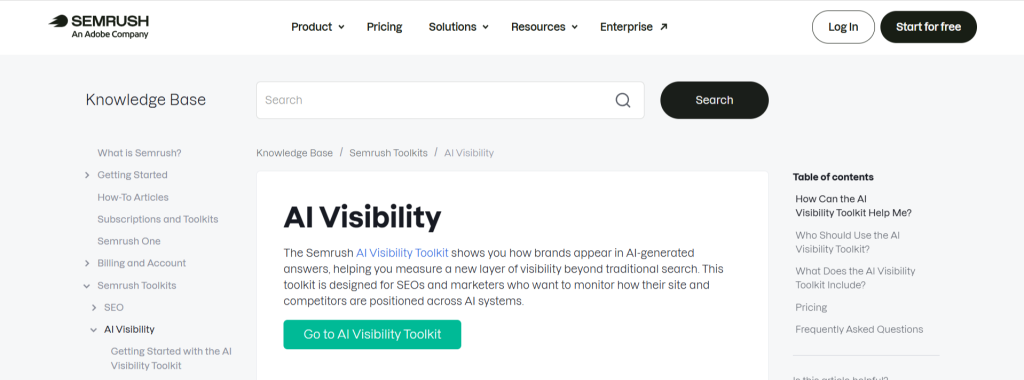
Semrush AI Visibility Toolkit suits teams that already run SEO programs and want AI data beside keyword and backlink data.
What you get :
- Brand tracking across ChatGPT, Google AI Mode, Gemini and Perplexity
- An AI search database of 130M+ prompts across eight regions, plus daily tracking of 25 prompts
- A Brand Performance report covering share of voice, sentiment and cited URLs
Pricing : The toolkit starts at $99/month per domain. Semrush One starts at $199/month and bundles the full SEO Toolkit with AI visibility. Enterprise AIO uses custom pricing.
Keep in mind : Backlinko ranks Semrush first in its own roundup, and Semrush owns Backlinko. Run a trial against one alternative before you commit. Explore the Semrush AI Visibility Toolkit.
2. Ahrefs Brand Radar : Best for Linking AI Citations to Backlink Data
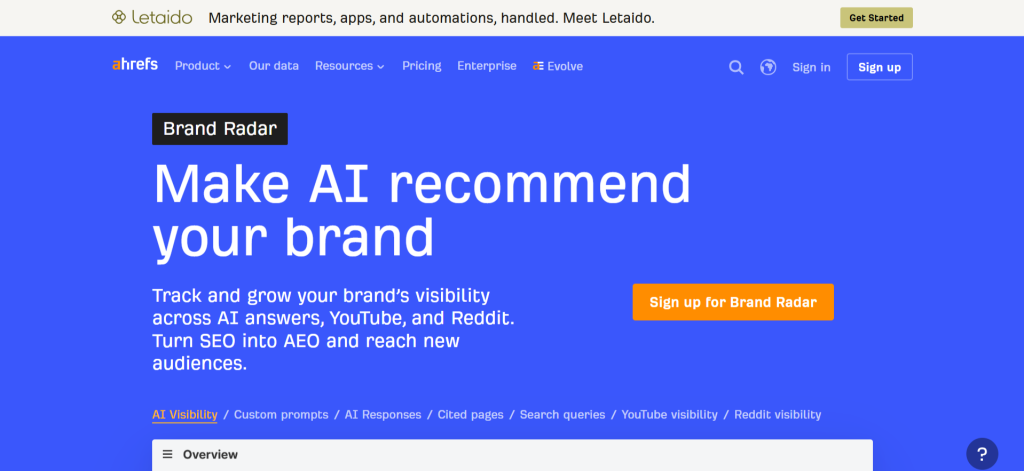
Ahrefs Brand Radar suits teams already paying for Ahrefs who want AI visibility inside the same workflow.
What you get :
- Monitoring across six AI platforms: Google AI Overviews, AI Mode, ChatGPT, Perplexity, Gemini and Copilot
- Metrics for mentions, citations, estimated impressions and AI share of voice
- Cited sources that open straight into backlink analysis, so you can plan outreach in one place
Pricing : Brand Radar costs $199/month per AI platform index or $699/month for all indexes. It requires an active Ahrefs base plan. Ahrefs shows different entry prices on different pages, so confirm at checkout.
Keep in mind : Ahrefs’ documentation does not list a dedicated sentiment score among Brand Radar’s core metrics. Pair it with another tool if sentiment matters to you.
3. Profound : Best for Enterprise-Scale AI Visibility
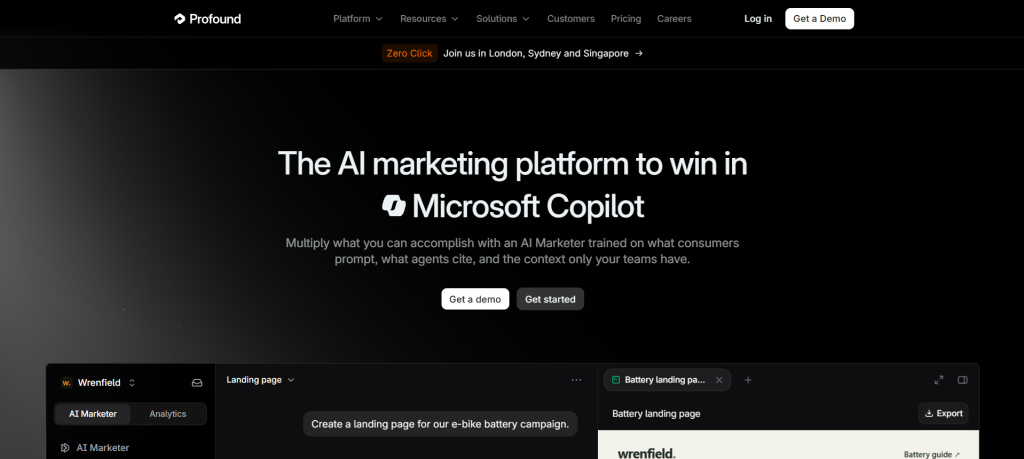
Profound suits large brands and enterprise SaaS teams that treat AI search as a primary channel.
What you get :
- Prompt-level tracking, page-level citation analysis and real-time AI crawl logs
- A Conversation Explorer that Profound says draws on over a billion real AI conversations
- Strong backing: a $96M Series C at a $1 billion valuation, led by Lightspeed in February 2026
Pricing : Starter costs $99/month billed yearly and covers ChatGPT only with 50 prompts. Growth costs $399/month for three engines and 100 prompts. Enterprise is custom-priced.
Keep in mind : Budget for Growth if you need more than ChatGPT. Learn more on the Profound website.
4. Peec AI : Best for Lean Teams and Multi-Country Tracking
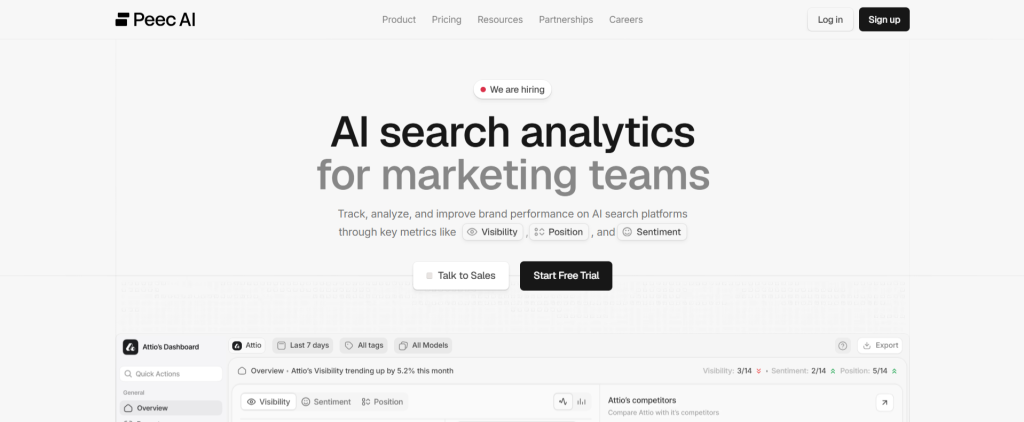
Peec AI suits marketing teams that want clean reports without enterprise complexity. It also suits UK and EU brands tracking several markets.
What you get :
- Visibility, position, sentiment and cited-source tracking
- A pick-three model menu from ChatGPT, AI Mode, AI Overviews, Copilot, Perplexity and Gemini
- Unlimited users on every plan
Pricing : Starter costs $95/month for 50 prompts. Pro costs $245/month for 150 prompts and three countries. Advanced costs $495/month for 350 prompts. EU Starter pricing lists at €85/month.
Keep in mind : Claude and several other models sit in the Enterprise tier only. See current plans on Peec AI.
5. Otterly.AI : Best Budget Entry Point
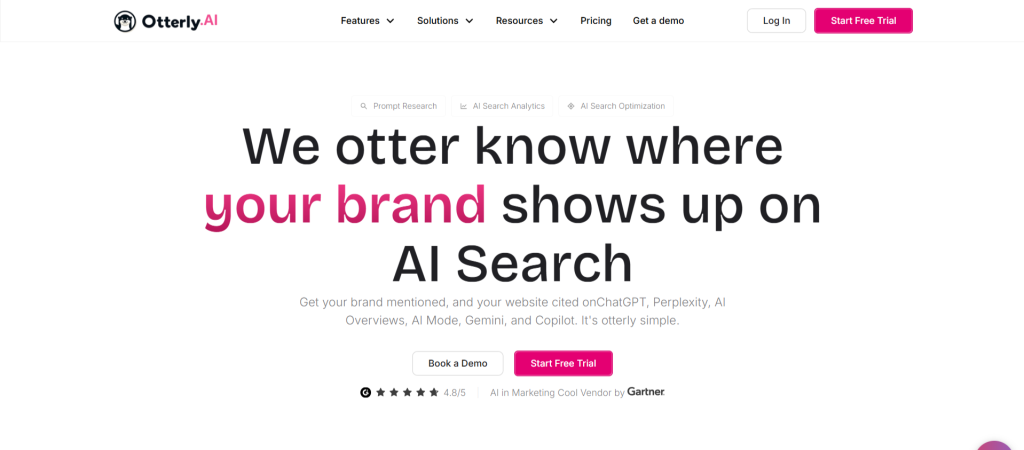
Otterly.AI suits startups, consultants and small agencies that want to start tracking this week.
What you get :
- Four core engines on every plan: ChatGPT, Google AI Overviews, Perplexity and Copilot
- Claude, Google AI Mode and Gemini as paid add-ons
- Daily runs, unlimited team members, 50+ countries and a detailed GEO audit
Pricing : Lite starts at $29/month for 15 prompts. Standard costs $189/month for 100 prompts. Premium costs $489/month for 400 prompts. Check the Otterly.AI pricing page for add-on fees.
Keep in mind : The jump from Lite to Standard is large. Plan your prompt count before you pick a tier.
Bonus : Growthner – Best for Done-for-You AI Visibility
Growthner is not a software tool. It is a SaaS SEO and GEO agency that tracks your AI visibility and then fixes the gaps. Choose this route if your team lacks time to turn data into content, citations and brand mentions.
What you get :
- A free AI visibility audit that tests 20 buyer prompts across ChatGPT, Claude, Gemini and Perplexity
- A visibility score plus your top three citation gaps, reviewed by a human
- Hands-on execution through GEO and LLM optimization, AI citation outreach, brand mentions and Reddit marketing
Pricing : Custom, based on your market and goals. The audit is free.
Keep in mind : A managed service works alongside a tracking tool, not instead of one. Many teams pair expert execution with Peec AI or Otterly.AI dashboards.
For a B2B SaaS client, we tracked 40 prompts in the Semrush AI Visibility Toolkit across ChatGPT, Gemini and Perplexity. AI mentioned the brand in 8% of answers at the start. We built comparison pages and earned review-site placements. After 90 days, the mention rate reached 27%.
Which AI Search Visibility Tool Should You Choose?
Choose your tool based on your current stack, budget and markets. Use this quick matrix.
| Your Situation | Best Pick | Why |
| You already use Semrush | Semrush AI Visibility Toolkit | AI data sits beside your keyword data |
| You already use Ahrefs | Ahrefs Brand Radar | Citations connect to backlink research |
| You run an enterprise brand | Profound | Deepest prompt data and engine coverage |
| You track US, UK and EU markets | Peec AI | Multi-country tracking from the Pro tier |
| You need to start under $50/month | Otterly.AI | Lowest credible entry price |
| You want experts to fix gaps for you | Growthner | Tracking plus hands-on content and citation work |
How Do You Set Up LLM Brand Tracking?
You set up LLM brand tracking by building a real buyer prompt set, adding competitors, and measuring for at least 30 days. Follow these steps:
- Collect real buyer questions : Pull them from sales calls, G2 reviews, support tickets and Reddit threads.
- Split prompts into two groups : Use branded prompts (“Is [brand] good for X?”) and unbranded prompts (“best tool for X”).
- Focus on unbranded prompts : These show whether AI recommends you to buyers who don’t know you yet.
- Add 3–5 competitors : Track at least 10 prompts against them for 30 days as your baseline.
- Set your markets : Run US prompts first, then add UK and EU locations if you sell there.
- Review cited sources monthly : These domains become your outreach and content targets.
What Are the Limits of AI Visibility Data?
AI visibility data shows trends, not exact positions. Keep three limits in mind.
- AI answers change on every run : SparkToro ran nearly 3,000 prompts across AI platforms. Identical brand lists appeared less than 1 in 100 times. Identical ordering appeared less than 1 in 1,000 times. Read the full SparkToro research on AI inconsistency.
- Tools measure differently : Some tools track live sessions, while others use synthetic prompts. Compare trends within one tool, not scores across tools.
- Visibility is not revenue : Visibility metrics don’t prove how many people saw an answer or clicked through. Pair your tool with GA4 referral data from AI platforms.
Start Tracking, Then Act on the Data
AI search visibility tools show you where your brand stands inside ChatGPT, Gemini and Perplexity. Pick the tool that matches your stack and budget. Build a real prompt set. Track for 30 days. Then use the gaps to guide your content and outreach.
Want to know where you stand today? Book a free strategy call with Growthner and get a clear AI visibility plan for your SaaS brand.
FAQs
1. What is the difference between an AI mention and an AI citation?
An AI mention happens when an engine names your brand in its answer. An AI citation happens when the engine links to or references a specific page on your site. Mentions build awareness. Citations prove AI trusts your content as a source. Strong brands earn both for their core buyer prompts.
2. Can you check AI visibility for free?
Yes. You can test prompts manually in ChatGPT, Gemini and Perplexity and log results in a spreadsheet. Paid tools add scale, history and competitor data. Growthner also offers a free AI visibility audit that tests 20 buyer prompts across four engines.
3. How many prompts should you track?
Start with 25–50 prompts that reflect real buyer questions. Weight them toward unbranded, high-intent prompts. Add more once you see which topics drive mentions.
4. How often should you review AI visibility data?
Review trends weekly and report monthly. Daily swings are normal because AI answers vary between runs.
5. Do AI visibility tools improve your rankings?
No. These tools measure visibility; they don’t change it. You improve visibility through better content, third-party mentions, reviews and crawler access.
6. Which tool works best for UK and European brands?
Peec AI and Otterly.AI both support multi-country tracking, and Peec lists EUR pricing. Semrush and Ahrefs offer regional data too, so check each plan’s markets.
About the Author


