
Last Updated on September 25, 2026 by Amit Kakkar
A document design software company came to us with a site that ranked on Google and had picked up some AI visibility along the way, but nothing was being done to earn it deliberately. Buyers were asking ChatGPT and other AI assistants which tools to use for proposals, reports and presentations, and the brand was showing up far less often than it should. Within 12 months, AI brand mentions grew from 150 to 259 and the number of pages cited by AI more than tripled.
| Metric | Before | After | Change |
|---|---|---|---|
| AI brand mentions | 150 | 259 | +73% |
| Pages cited by AI platforms | 500 | 1,600+ | 3.2x |
| Monthly referral visitors from ChatGPT | Not tracked | ~1,000 | New channel |
| Monthly organic search visitors | 1,700 | 17,000 | 10x |
The organic growth matters, but it is the supporting story. The headline is that AI assistants now recommend and cite this brand, and send it a steady stream of visitors who arrive already primed by an AI answer.
How we measured it : AI citations were tracked in Semrush. For prompt tracking, we ran a fixed set of category prompts through the DataForSEO API to monitor how often, and where, AI assistants named the brand.
The challenge : strong product, invisible in AI answers
The client had a good product and some existing AI visibility, but it was incidental rather than earned. When we looked at how ChatGPT and other AI tools answered category questions, three gaps were limiting how often the brand was named and cited.
- Content AI could not easily extract : Pages mixed several ideas under vague headings, rarely answered a question directly, and buried the useful part deep in the page. AI models pull short, self-contained answers, and this content did not offer many.
- Thin topical coverage : The site covered its core topics in isolated posts rather than connected clusters. Without depth and clear relationships between pages, AI systems had no signal that this brand was an authority on document design.
- Few third-party signals : AI assistants lean heavily on what other trusted sites say about a brand. Mentions on relevant industry sites were scarce, and the existing backlink profile was mostly irrelevant domains that added nothing to the brand’s credibility.
Underneath all of this sat technical issues (slow pages, crawl problems, broken links, weak metadata) that limited how well both search engines and AI crawlers could read the site.
Our GEO strategy
We built the program around one question: what would make an AI assistant confident enough to name this brand and cite its pages? The answer came down to four workstreams.
1. Restructuring content so AI can lift answers from it
We reworked priority pages so each section answers one question clearly and completely. That meant descriptive headings that mirror how people phrase their questions, a direct answer in the first lines of each section, Q&A blocks for common follow-up questions, and cleaner semantic structure throughout. The goal was simple: any passage an AI pulls from the page should make sense on its own.
2. Building topical authority AI can recognise
We mapped the questions buyers ask about document design and built connected content clusters around them. Each cluster pairs a strong pillar page with supporting pieces, all tightly linked, so the site covers each topic from several angles. Regular refreshes kept key pages current, which matters because AI systems favour up-to-date sources.
3. Earning brand mentions on sites AI trusts
AI assistants form their view of a brand largely from what other sites say about it. We ran outreach campaigns to get the brand mentioned alongside relevant tools on trusted industry sites and publications, and earned links from high-authority domains (DA 80+). Consistent brand messaging across these placements helped AI models build a clear, accurate picture of what the product does and who it is for.
4. Creating citation-worthy resources
We produced educational content designed to be the best answer available: complete, accurate, full of practical examples and detailed explanations.
The SEO foundation behind it
GEO does not work on a site that crawlers struggle to read, so we fixed the fundamentals first. We improved page speed, repaired broken links and redirects, cleaned up heading hierarchy and metadata, added structured data, and resolved crawl and indexing issues. We also refocused the keyword strategy on high-intent, commercially relevant terms and tightened internal linking across the new clusters.
This groundwork served both channels at once. The structure that made pages easier for AI to cite also helped them climb Google rankings, taking organic traffic from 1,700 to 17,000 monthly visitors in a year.
Results
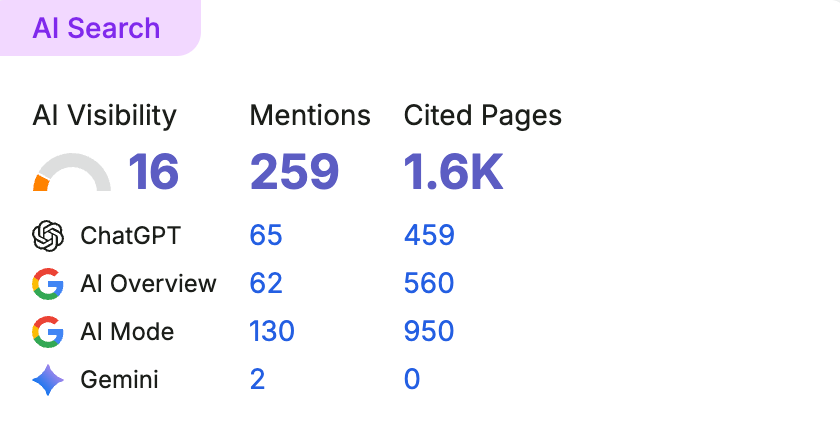
- 259 AI brand mentions, up from 150 (+73%) : The brand now shows up by name far more often when AI assistants answer questions in its category, putting it on more of the shortlists buyers see.
- 1,600+ pages cited by AI platforms, up from 500 (3.2x) : Content across the site is being used as a source in AI-generated answers, not just a handful of flagship pages.
- ~1,000 monthly visitors from ChatGPT : AI answers have become a measurable acquisition channel. These visitors arrive after an assistant has already explained the problem and pointed to the product, so they land with context and intent.
- 10x organic search traffic : Monthly organic visitors grew from 1,700 to 17,000, with stronger rankings for high-intent commercial keywords and a much healthier backlink profile.
What this means for SaaS teams
Ranking on Google is no longer the whole picture. Buyers increasingly start their research inside an AI assistant, and the brands that get named there win attention before a search results page ever loads. This project showed that AI visibility can be built deliberately: structure content so it can be quoted, go deep on the topics you want to own, and earn mentions on the sites AI models trust.
Want to know how often AI assistants recommend your brand today?
Get a GEO audit and we will show you where you appear, where competitors are winning, and what it will take to close the gap.
About the Author


