
Last Updated on August 19, 2026 by Amit Kakkar
TL;DR – Quick Summary
The 11 LLM optimization agencies in this guide each take a different angle on getting SaaS brands cited inside AI surfaces – ChatGPT, Perplexity, Google AI Overviews, Gemini, and Claude. Strong fits by profile include iPullRank, Conductor, Skale, Omnius, Flow SEO and Growthner. The most important decision criterion isn’t agency size, it’s whether the agency can prove tracked citation movement on named LLMs using real monitoring tools. This guide includes a selection methodology, an 11-agency comparison table, “Watch Out For” notes per agency, and an 8-point verification checklist for shortlisting any LLM optimization partner.
Why LLM Optimization Matters Now
Click-through rates for top organic results have meaningfully declined in markets where Google’s AI Overviews now appear. Authorities published research in 2025 documenting Google AI Overviews drive 61% drop in organic CTR, 68% in paid.
Independent studies from SE Ranking and Semrush have reached directionally similar conclusions, and SparkToro’s long-running zero-click research (Rand Fishkin) shows that the majority of US Google sessions already end without a click to any external site.
Whatever the precise figure in any single study and figures vary by methodology, country, and query type – the conclusion is consistent: a growing share of buyer research happens inside AI surfaces (ChatGPT, Perplexity, Google AI Overviews, Gemini, Claude) rather than on a destination website.
That shift has reshaped how SaaS companies need to think about discovery, and it has created a new category of specialist agency: the LLM optimization or generative engine optimization (GEO) agency.
These agencies optimize landing pages, blog content, comparison pages, and third-party signals (Reddit, G2, YouTube, Wikipedia) so that LLMs cite, reference, and recommend a brand inside generated answers, not just rank it on a SERP.
How We Selected These Agencies
We started with roughly 30 agencies marketing LLM optimization, AI SEO, or GEO services and applied six criteria:
- Demonstrated GEO/LLM service offering : not just rebranded SEO. Agencies needed to publish substantive material on AI search optimization (frameworks, case studies, monitoring methodology) rather than swap “AI SEO” into existing copy.
- SaaS-relevant client base : published case studies, logos, or named work with B2B SaaS, AI/dev-tools, or comparable subscription software companies.
- Multi-platform coverage : ability to optimize for at least three of: ChatGPT, Perplexity, Google AI Overviews/Gemini, Claude, Copilot.
- Operational track record : at least two years of operation under the current service offering, so we could see client outcomes rather than projections.
- Tracking and reporting maturity : documented use of LLM monitoring tools (Profound, Otterly, Peec.ai, Athena HQ, or proprietary equivalents) or clearly described measurement methodology.
- Public credibility signals : named team members, case studies with measurable outcomes, conference talks, or original research published under the agency’s name.
The list below is not strictly ranked. Each entry includes a “Best fit” profile so you can match an agency to your stage and priorities rather than assume position-1 means best for you.
Comparison Table
| Agency | Founded | HQ | Team Size | Pricing | SaaS Focus | LLM Platforms Covered |
| Growthner | 2014 | Global (US/UK/EU focus) | 15+ | Custom | Primary (publisher) | |
| AIclicks | 2024 | Vilnius, Lithuania | 10-25 | Published per-service (from $250) | Primary (B2B SaaS) | ChatGPT, Perplexity, Gemini, Claude, AI Overviews, AI Mode, Copilot, Grok |
| iPullRank | 2014 | New York, USA | 30–50 | Custom (premium) | Mid-market & enterprise | ChatGPT, Perplexity, Gemini, Claude, Copilot |
| Animalz | 2015 | Remote (US-based) | 50–100 | Custom (mid–premium) | Primary | ChatGPT, Perplexity, Gemini |
| Conductor | 2010 | New York, USA | 250+ | Enterprise SaaS + services | Enterprise (mixed) | ChatGPT, Perplexity, Gemini, Copilot |
| Skale | 2018 | Remote (Spain / EU) | 15–30 | Custom | Exclusive (B2B SaaS) | ChatGPT, Perplexity, Gemini |
| Omnius (Ominus) | 2020 | Europe | 10–25 | Custom | Primary | ChatGPT, Perplexity, Gemini |
| 42DM | 2015 | Cyprus / EU | 30–50 | Custom | Primary (B2B / SaaS) | ChatGPT, Perplexity, Gemini |
| Avenue Z | 2017 | New York / Tampa, USA | 50–100 | Custom | Mixed | ChatGPT, Perplexity, Gemini |
| Growth Marketing Pro | 2017 | USA (remote) | 15–30 | Custom | Primary (SaaS) | ChatGPT, Perplexity, Gemini |
| Digital Brand Expressions | 1998 | New Jersey, USA | 10–20 | Custom | Mixed | ChatGPT, Perplexity, Gemini |
| Flow SEO | 2014 | Remote (Berlin/EU) | 10–20 | Custom | Primary | ChatGPT, Perplexity, Gemini |
Numbers in this table reflect public information at time of writing and should be verified against agency websites before final publication. “Custom” pricing means the agency does not publish public price tiers.
Top 12 Best LLM Optimization Agencies for SaaS in 2026
Here is the list of the best LLM optimization agencies for SaaS in 2026 and beyond. Compare and choose one that best fits your budget and needs.
1. Growthner — AI Friendly SEO and GEO for SaaS Growth
Best for : Mid-market SaaS combining traditional SEO with GEO
Founded : 2014
HQ : Global (US/UK/EU focus)
Team : 15+
Disclosure : Growthner is the publisher of this guide. See the editorial transparency statement at the top.
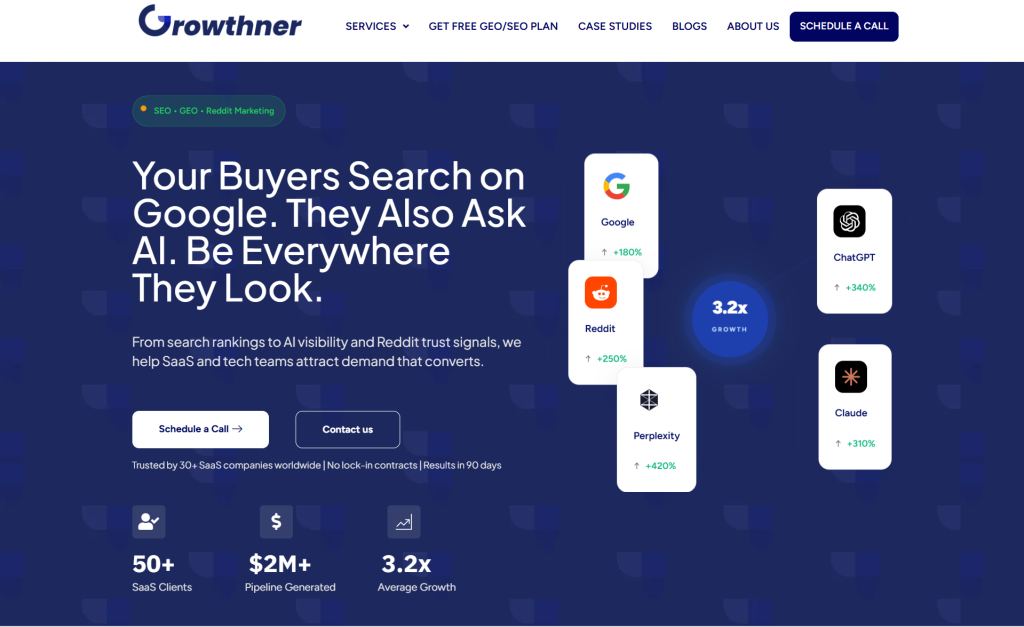
Growthner combines traditional SaaS SEO with a dedicated LLM optimization practice, with a particular focus on how content needs to be structured (format, tone, and entity coverage) for selection by AI models. The team works across ChatGPT, Perplexity, Gemini, and Claude, and pairs on-page GEO work with off-site signal building – Reddit, Quora, and structured brand mentions that LLMs draw on when generating answers.
The agency works with SaaS companies in fintech, e-commerce, and developer tools, primarily in US and European markets.
Key services : Strategic keyword placement, content audits for GEO, natural language query optimization, LLM-optimized content generation, Reddit and Quora marketing, brand mention building.
Watch out for : A 15-person team is leaner than enterprise firms. Companies needing 30+ pieces of content monthly or sprawling international rollouts should explicitly validate capacity in discovery. Mid-market SaaS is the sweet spot.
2. AIclicks – Owns the Monitoring Platform It Reports With
Best for : SaaS teams that want tracking and execution from one vendor
Founded : 2024
HQ : Vilnius, Lithuania
Team : 10-25
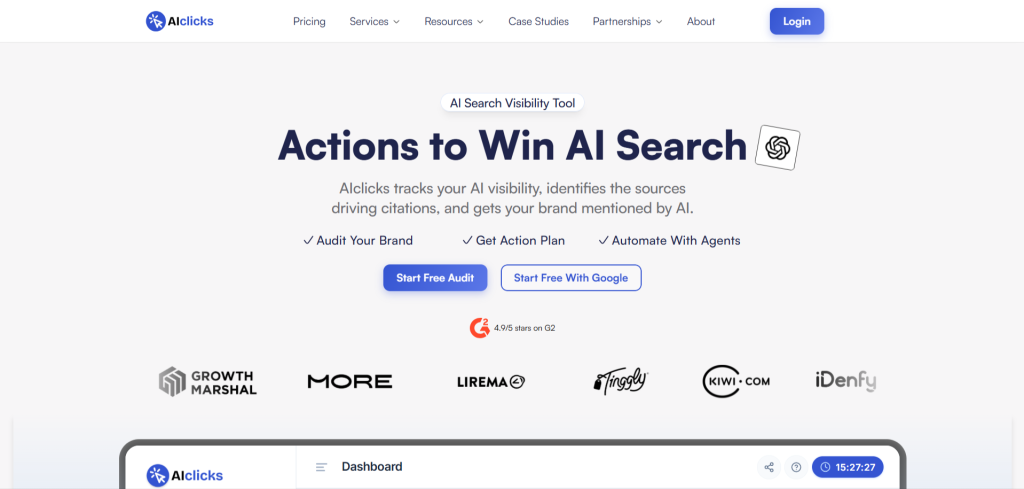
Every other agency in this table lists “Custom” under pricing. AIclicks publishes a rate card: $1,500 for an LLM visibility action plan, $750 for a technical audit of what’s blocking AI crawlers, $250 per brand mention placed, $75 per Reddit comment.
A SaaS team that wants to test whether GEO does anything for its category can buy one audit and a handful of mentions, see what moves, and decide about a retainer afterward.
What makes that work is that AIclicks built the tracking layer first and added services on top, not the reverse. The platform runs your prompt set daily across ChatGPT, Claude, Perplexity, Gemini, Google AI Overviews, AI Mode, Copilot and Grok, classifies every cited URL by page type, and stays with you at $59 to $499 a month whether or not you buy any delivery work.
Key services : LLM visibility action plans, Reddit and UGC engagement programs, citation-engineered content, brand mention building across sources LLMs cite, entity work (Wikipedia, Wikidata, Crunchbase, schema), LLM technical audits.
Watch out for : Per-deliverable pricing puts the sequencing on you. An audit plus three mentions doesn’t compound the way a directed six-month program does, so either buy the action plan first or expect to hand someone the roadmap.
3. iPullRank – Technical and Entity – Level Depth
Best for : Mid-market and enterprise SaaS with complex sites
Founded : 2014
HQ : New York, USA
Team : 30 – 50
iPullRank, founded by Mike King, has been writing publicly about entity-based SEO and large-language-model retrieval since well before “GEO” became a marketing label. That early commitment shows in their methodology: they treat LLM optimization as a technical and entity-modeling problem first, with content production layered on top. Their published research and conference talks (SMX, MozCon) on retrieval-augmented generation and AI search are widely cited inside the industry.
For SaaS companies with large content libraries, technical-debt-laden sites, or complex product taxonomies, iPullRank’s depth is unusual. They will dig into structured data, internal linking, and entity disambiguation in ways shorter-staffed agencies cannot.
Key services : Entity-based SEO, structured data and schema, technical SEO audits, LLM/GEO optimization, content engineering, generative AI integration consulting.
Watch out for : Pricing is at the premium end; not a fit for early-stage SaaS or budgets under roughly $10K/month. Engagements are senior-led and deliberate, not fast.
4. Animalz – Editorial Depth for Authority Building
Best for : Content-led SaaS aiming for citation in AI summaries
Founded : 2015
HQ : Remote (US-based)
Team : 50 – 100
Animalz is one of the most recognized B2B SaaS content agencies, with a long-standing reputation for original thinking and deep-research articles. Their LLM-era pivot has been to lean harder into the qualities that make content citation-worthy: original data, first-hand experience, and structural clarity that LLMs can extract cleanly into summaries.
Their work is well-suited to brands trying to establish thought leadership in a category – fewer comparison pages, more editorial pieces that own a perspective. They are not a technical-SEO-first agency.
Key services : AI-aware content strategy, long-form SaaS content, editorial positioning, topical authority development, content optimization for AI summaries.
Watch out for : Light on technical SEO and link building. If your bottleneck is site architecture, schema, or comparison-page conversion rather than editorial quality, Animalz alone won’t close the gap.
5. Conductor – Enterprise – Scale Platform + Services
Best for : Large enterprise SaaS with multi-team SEO ops
Founded : 2010
HQ : New York, USA
Team : 250+
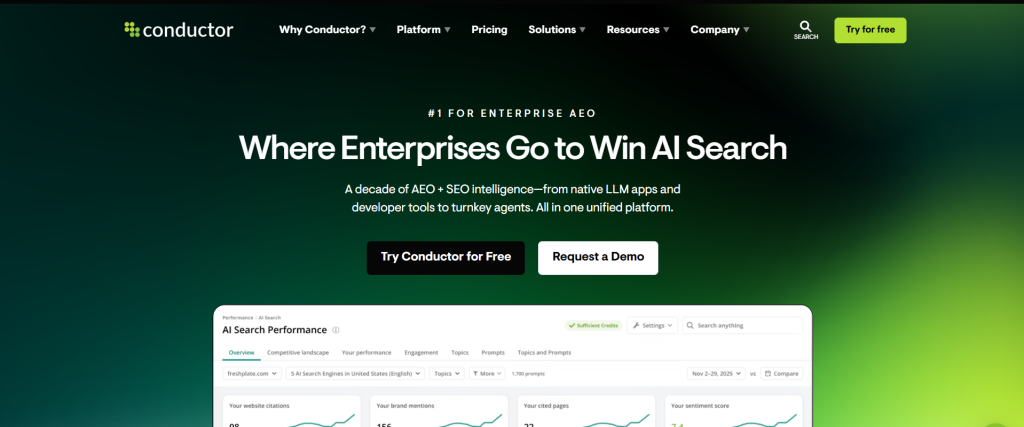
Conductor is primarily a SaaS platform, Conductor Intelligence with a strong professional services arm built around it. Their AI visibility tracking, content insights, and analytics are enterprise-grade and integrate with the kind of complex marketing stacks large SaaS companies actually run. They’ve added meaningful AI search and LLM citation tracking into the core platform.
For enterprises with internal SEO teams, multiple business units, or governance requirements (compliance, accessibility, multi-region), Conductor offers tooling and processes that a 15-person agency cannot match.
Key services : AI visibility tracking, content insights, SEO analytics platform, technical SEO, content optimization workflows, enterprise CRO.
Watch out for : Wrong fit for early-stage SaaS or companies without internal SEO headcount. Platform pricing alone exceeds the entire SEO budget of many growth-stage companies. Buy if you need a system; skip if you need a hands-on agency.
6. Skale – Revenue – Focused AI Search for SaaS
Best for : Growth-stage SaaS treating AI search as a pipeline channel
Founded : 2018
HQ : Spain (remote across Europe)
Team : 15 – 30
Skale is built exclusively for B2B SaaS, and their positioning around AI search is unusually disciplined: they care about pipeline influence and revenue attribution, not citation counts. Their proprietary AI attribution framework attempts to connect AI-driven discovery to closed-won deals, a hard problem that most agencies handwave through.
Their client roster (Slite, Pitch, Maze, others) skews toward modern, product-led SaaS where buying happens fast and content quality is non-negotiable.
Key services : AI search optimization (AEO), traditional SEO, content repurposing for AI, brand authority building, demand influence tracking.
Watch out for : The revenue-attribution story requires a working CRM and clean lead-source data on the client side. If your analytics are immature, expect a longer setup before the reporting works as advertised.
7. Omnius – Specialist GEO for Early – Stage SaaS
Best for : AI-first and early-stage SaaS getting started with GEO
Founded : 2020
HQ : Europe
Team : 10 – 25
Omnius (sometimes spelled “Ominus” in roundups) has positioned itself as a specialist in AI search and LLM visibility from early on. They combine traditional SEO fundamentals – keyword research, competitor analysis, content strategy with a layer of GEO-specific work content structuring for retrieval, entity coverage, AI-engine competitive analysis, and content freshness audits geared toward AI summary inclusion.
Their team is smaller than the enterprise players above, which means founder access and faster iteration cycles, at the cost of less depth on the engineering and platform side.
Key services : AI-engine competitive analysis, GEO-focused content generation, AI SEO keyword research, audience and persona research, content gap identification.
Watch out for : Smaller team means capacity is finite. Confirm how many active engagements each strategist carries before signing – a 10-person agency at full utilization has different responsiveness than the same agency at 60%.
8. 42DM – EEAT – Led AI Content for B2B
Best for : B2B and SaaS brands building AI search visibility from scratch
Founded : 2015
HQ : Cyprus / EU
Team : 30 – 50
42DM has made Generative AI Search Optimization a core service line, with content workflows built around EEAT (experience, expertise, authoritativeness, trust) signals that both Google’s quality systems and modern LLMs reward. They cover the full stack – keyword research, schema, site structure, content production with explicit attention to AI-search readiness.
The agency publishes case studies claiming meaningful AI-search visibility lifts within 60–90 days. Those numbers should be validated against named clients during a discovery call.
Key services : Content marketing strategy, SEO copywriting and keyword integration, third-party trust signal building, technical foundation for AI search, readability and tone optimization.
Watch out for : “Visibility within two months” claims are aggressive in a discipline where most measurement frameworks need 60–90 days just to baseline. Ask for the specific monitoring tool used and the methodology for the lift number before signing.
9. Avenue Z – Earned Media Plus AI Visibility
Best for : Growing SaaS brands that also need PR muscle
Founded : 2017
HQ : New York / Tampa, USA
Team : 50 – 100
Avenue Z’s distinguishing feature is the integration of digital PR and earned media with AI search optimization. Because LLMs draw on a wider pool of sources than the traditional SERP – news sites, wikis, forums, podcasts – agencies with real PR capability can move the needle on AI citations in ways pure SEO shops cannot.
They serve clients across SaaS, finance, and consumer brands, with strategy built around earned mentions feeding AI training and retrieval pipelines.
Key services : Technical AI enhancements, content marketing strategy, SEO copywriting, content freshness audits, AI SEO keyword research, digital PR integration.
Watch out for : Their mixed industry focus means SaaS expertise varies by team. Ask which strategists have specific SaaS experience and request to meet that team during onboarding rather than the senior business-development contact.
10. Growth Marketing Pro – Speed – to – Market Generalist
Best for : SaaS teams needing fast launches across multiple channels
Founded : 2017
HQ : USA (remote)
Team : 15 – 30
Growth Marketing Pro positions itself around speed: strategy in days, campaigns in weeks. Their LLM optimization work covers the surfaces LLMs actually pull from Wikipedia, Reddit, listicles, PR, LinkedIn, YouTube, niche industry sites alongside on-site SEO and CRO. They’re a fit for SaaS teams that want to compress trial-and-error cycles and don’t have time to wait six months for a research-first agency.
Beyond LLM visibility, they do landing-page CRO and funnel work – closer to a generalist growth agency with strong AI-search awareness than a pure GEO specialist.
Key services : LLM optimization, generative engine optimization, SEO content creation, link building, technical SEO, structured data, paid and social ads.
Watch out for : Speed-first approaches sometimes skip the discovery depth that complex SaaS products need. If your category is technical or your buyer journey is long, push back on the standard timeline and insist on a longer onboarding.
11. Digital Brand Expressions – SAIO Framework Pioneer
Best for : Brands focused specifically on AI answer placement
Founded : 1998
HQ : New Jersey, USA
Team : 10 – 20
Digital Brand Expressions (DBE) calls their methodology SAIO – Search Artificial Intelligence Optimization and was among the first agencies to publish a structured framework for it. Having tested early generative search engines, they built SAIO around a specific problem: getting brands cited inside AI answers even when no link is included.
DBE is a long-running agency (founded in 1998) with a comparatively small team. The SAIO framework is their differentiator; depth elsewhere is more limited.
Key services : Discovery and goal setting, audit and planning, content restructuring for AI selection, technical setup, ongoing testing, and refinement.
Watch out for : Smaller team and a single-framework focus means less coverage for adjacent needs (heavy technical SEO, large content production, paid). If you need more than SAIO, you’ll need other partners.
12. Flow Agency – Practical AI Search Refresh
Best for : SaaS teams updating existing content libraries for AI search
Founded : 2014
HQ : Remote (Berlin / EU)
Team : 10 – 20
Flow Agency formerly Flow SEO, focuses on the practical work most SaaS teams actually need: updating existing blog posts, product pages, and comparison pages so they perform well across AI answers and traditional organic search. Their approach emphasizes topical authority, entity clarity, and internal linking – the structural fundamentals that make content easier for LLMs to interpret and cite.
Best fit for SaaS teams with an existing content library that needs to be re-engineered for AI search rather than rebuilt from zero.
Key services : LLM-focused content optimization, AI search visibility audits, topical authority and entity mapping, internal linking optimization, and content refresh for AI summaries.
Watch out for : Smaller team means limited capacity for net-new content production at scale. The strength is auditing and optimizing what exists, not building a 200-article content engine from scratch.
How to Verify an LLM Optimization Agency’s Claims
LLM optimization is a young enough discipline that vendor claims outpace verifiable results. Before signing a contract, work through this checklist with any agency on your shortlist.
1. Ask for tracked citations in named LLMs, with dates : Generic “we improved AI visibility” claims mean nothing. Ask for screenshots or monitoring-tool exports showing specific brand citations in ChatGPT, Perplexity, or Google AI Overviews on specific queries, on specific dates. If they cannot produce this, they likely aren’t measuring it.
2. Ask which monitoring tool they use : Credible agencies use Profound, Otterly, Peec.ai, Athena HQ, or comparable LLM monitoring platforms or have built proprietary tracking. “We use ChatGPT” is not a tracking methodology. Ask to see a sample monitoring dashboard from a real (anonymized) client.
3. Test their understanding of training data vs retrieval vs live search : LLMs surface information through different mechanisms: pre-trained knowledge (frozen at the model’s training cutoff), RAG/retrieval (live search at query time, used by Perplexity and ChatGPT search), and agentic browsing. Optimization tactics differ across these. An agency that conflates them will optimize the wrong things.
4. Ask which platforms they have proven resultson, not which they “support” : Most agencies will claim coverage of every major LLM. Push for specifics: “Show me a client where you moved citation share in Perplexity” is a different question than “Do you optimize for Perplexity?” The first reveals capability; the second reveals only marketing copy.
5. Be skeptical of any ranking or citation guarantee : LLM responses are non-deterministic – the same query can produce different cited sources across sessions, users, and model versions. Any agency promising “we’ll get you cited in ChatGPT for query X” either misunderstands the technology or is willing to lie. Credible agencies promise process and probability, not guaranteed placements.
6. Ask whether they have published GEO research themselves : Agencies doing serious work in a young field tend to publish conference talks, original studies, and methodology breakdowns. An agency with zero published thinking on LLM optimization but a fully built service page deserves extra scrutiny.
7. Request anonymized timeline data : Citations grew 4x in 90 days” is a claim. A weekly time-series chart, with the methodology footnoted, is evidence. Demand the latter.
8. Confirm what counts as a deliverable : Some agencies deliver content; some deliver content plus monitoring; some deliver strategy and hand execution back to your team. Get clarity on monthly artifacts (audits, content pieces, dashboards, reports) before signing.
Conclusion
The shift from traditional search to AI-powered discovery is no longer a forecast it’s a current condition of buyer research. SaaS companies that ignore LLM optimization risk losing visibility in the surfaces where their prospects increasingly start the buying journey.
The agencies in this guide each bring a distinct angle: technical depth (iPullRank), editorial authority (Animalz), enterprise scale (Conductor), revenue focus (Skale), specialist GEO (Omnius, Flow SEO, Growthner), framework-driven approach (DBE), or speed-to-market generalism (Growth Marketing Pro, 42DM, Avenue Z). The right partner depends on your stage, content library, and how mature your measurement infrastructure already is.
Use the verification checklist above on every agency you shortlist. The discipline is too new and too easy to fake for marketing copy alone to carry the decision. If you’d rather start by understanding the tactics yourself before hiring, our companion piece on how to get your SaaS ranked on ChatGPT and Perplexity walks through the on-page and off-site fundamentals.
If you’d like to evaluate Growthner alongside the other agencies in this list, we offer a free consultation on your LLM optimization strategy. Our practice combines traditional SaaS SEO with dedicated GEO services across ChatGPT, Perplexity, Gemini, and Claude, plus Reddit and structured brand-mention work that feeds the third-party signals LLMs rely on.
Get in touch with Growthner today!
FAQs
1. What is LLM optimization and how is it different from traditional SEO?
LLM optimization (also called AI SEO or GEO) focuses on making your content visible in AI-powered search engines like ChatGPT, Perplexity, and Google’s AI Overviews. Unlike traditional SEO which targets keyword rankings on search engine results pages, LLM optimization ensures your brand gets cited and referenced in AI-generated answers. It involves structuring content for machine comprehension, building topical authority, and earning mentions across authoritative sources that LLMs use as training data.
2. Why do SaaS companies need an LLM optimization agency?
SaaS companies need LLM optimization because AI search engines are rapidly changing how buyers discover and evaluate software. With organic CTR declining by over 30% and 60% of AI searches ending without a website visit, SaaS businesses risk losing visibility if they rely solely on traditional SEO. An LLM optimization agency helps ensure your product appears in AI-generated recommendations, comparisons, and answers where potential customers are increasingly making purchase decisions.
3. How do LLM optimization agencies improve AI search visibility?
LLM optimization agencies use several strategies including optimizing content structure for AI comprehension, building brand mentions across high-authority sources, creating content that answers specific queries LLMs pull from, improving entity recognition and topical authority, and monitoring how AI models reference your brand. They also focus on earning citations rather than just backlinks, since AI search often surfaces brands without linking to them.
4. How long does it take to see results from LLM optimization?
LLM optimization is a medium to long-term strategy. Initial improvements in AI search mentions can be seen within 2 to 4 months, but building consistent visibility across multiple AI platforms typically takes 4 to 8 months. The timeline depends on your existing domain authority, the volume of content already published, and how quickly new authoritative mentions can be built across the web.
5. Can LLM optimization work alongside traditional SEO?
Yes, LLM optimization and traditional SEO complement each other. Strong traditional SEO provides the foundation of quality content, domain authority, and backlinks that LLMs also reference when generating answers. The best approach is an integrated strategy where traditional SEO drives organic search traffic while LLM optimization ensures your brand is visible in AI-generated search results, covering both channels where your customers are searching.
6. How do I measure the success of LLM optimization?
Measuring LLM optimization success involves tracking brand mentions in AI-generated answers across platforms like ChatGPT, Perplexity, and Google AI Overviews. Key metrics include share of voice in AI search results, frequency of brand citations, referral traffic from AI platforms, and sentiment analysis of how AI models describe your product. Many LLM optimization agencies provide specialized dashboards and monitoring tools to track these metrics.
About the Author
Amit Kakkar is the founder of Growthner and has spent over a decade working on organic growth for SaaS companies. He has led SEO and LLM optimization strategies for 100+ B2B and B2C SaaS brands across the US, UK, and Europe, with a particular focus on the transition from traditional search to AI-powered discovery (ChatGPT, Perplexity, Google AI Overviews, Claude). Amit writes regularly about generative engine optimization, content frameworks for AI summary inclusion, and the technical SEO challenges specific to product-led growth companies. His client work spans fintech, e-commerce, and developer tools verticals.
You can reach Amit on LinkedIn.
About the Author


