



Free Strategy
Get a Free SEO
Growth Plan
Actionable insights tailored for your business
Apply now
Published by: Amit Kakkar
Published on: September 8, 2024
Last updated on: July 15, 2026
Last Updated on July 15, 2026 by admin
Our client, a Document Design software company, wanted to increase qualified organic traffic, improve keyword rankings, and build long-term authority in a competitive SaaS market. While the website had valuable content, technical issues, weak authority signals, and an ineffective content strategy limited its ability to rank in Google and appear in AI-powered search experiences.
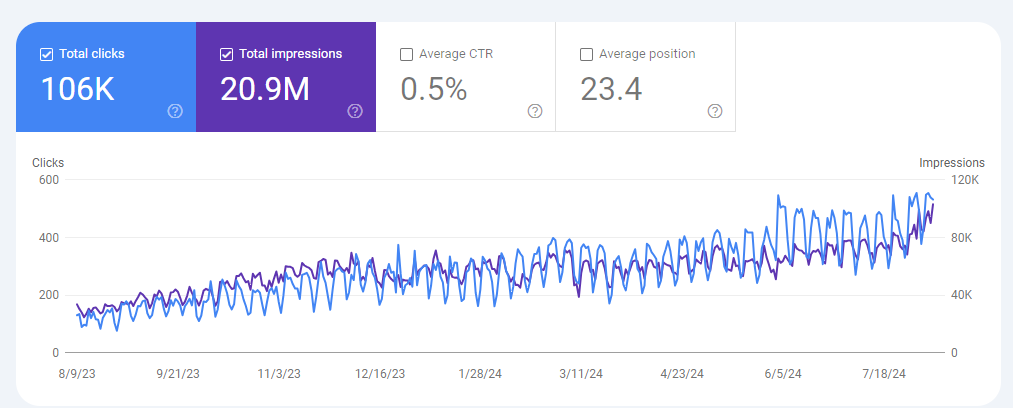
Over the course of 12 months, we implemented a combined SEO and GEO (Generative Engine Optimization) strategy that significantly improved both traditional search performance and AI visibility.
1,700 visitors
17,000 visitors
900% increase in one year
The website had several technical SEO problems that were limiting its search performance. Slow page load speeds, broken internal links, improper heading structures, missing or poorly optimized metadata, and crawling issues prevented search engines from efficiently understanding and indexing the site. These issues also affected the overall user experience.
The client’s backlink profile consisted largely of low-quality and irrelevant websites. These backlinks weakened the site’s authority and limited its ability to compete for valuable keywords.
The existing content lacked a clear keyword strategy. There was little focus on the search terms potential customers were actually using, resulting in low visibility for high-intent queries and missed opportunities to capture qualified traffic.
Although the website contained useful information, it was not structured in a way that AI assistants could easily understand, reference, or cite. The content lacked topical depth, semantic organization, and authority signals that modern AI search systems increasingly rely on.
We started with a complete technical SEO audit to identify and resolve issues affecting the website’s performance.
Our work included:
These improvements created a stronger technical foundation for both users and search engines
We performed extensive keyword research to identify high-intent search opportunities within the document design software market.
Our content strategy focused on:
This helped the website gain visibility across a much broader set of search queries.
To strengthen domain authority, we launched a strategic backlink acquisition campaign.
Our approach included:
These authority signals significantly improved the website’s ability to compete in organic search.
As AI-powered search continues to influence how people discover software products, we expanded our optimization strategy beyond Google rankings. Our objective was to increase the likelihood that AI platforms such as ChatGPT would reference the client’s content when answering user questions.
We optimized content to make it easier for large language models to understand and retrieve information.
This included:
Rather than publishing isolated articles, we built content clusters around important industry topics.
This helped establish the website as an authoritative source while improving contextual relevance across related pages.
To strengthen the client’s presence across AI search, we focused on building stronger authority signals by:
AI assistants are more likely to reference complete, trustworthy, and well-structured resources.
We therefore focused on creating content that:
This increased the likelihood of the website being cited within AI-generated responses.
Our integrated SEO strategy increased monthly organic traffic from 1,700 visitors to 17,000 visitors, representing a 900% increase within 12 months.
The website experienced substantial improvements in rankings for high-intent commercial keywords, resulting in more qualified organic visitors and greater visibility throughout the customer journey.
High-authority backlinks from trusted websites strengthened the client’s backlink profile, improved domain authority, and contributed to sustained ranking improvements.
Our optimization efforts also produced measurable gains across AI-powered search platforms.
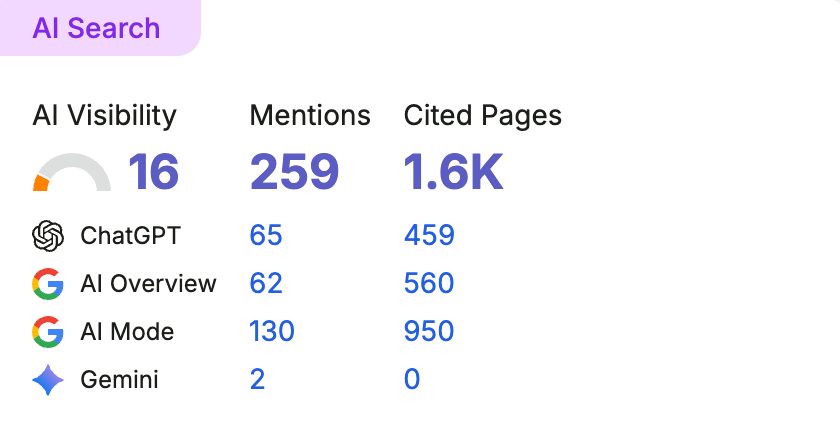
The brand now receives approximately 259 mentions across AI-generated responses, increasing visibility beyond traditional search engines.
The website has accumulated more than 1,600 cited pages, demonstrating that AI platforms increasingly rely on its content as a trusted information source.
ChatGPT has become a meaningful acquisition channel, generating approximately 1,000 visitors per month through AI-generated recommendations and citations.
These results show that organic growth is no longer driven solely by Google rankings. Visibility within AI search has become an additional source of qualified traffic and brand awareness.
This project demonstrates how modern organic growth requires more than traditional SEO alone.
By combining technical SEO improvements, strategic keyword research, content optimization, authoritative link building, and GEO best practices, we transformed the client’s visibility across both search engines and AI-powered platforms.
Over the course of one year, we achieved:
The outcome was not only higher Google rankings but also greater visibility in AI-generated answers, creating an additional and growing source of qualified traffic.
As search continues to evolve, businesses that build authoritative, trustworthy, and well-structured content will be positioned to succeed across both traditional search engines and AI-powered discovery platforms. This case study demonstrates that when SEO and GEO work together, they create sustainable long-term growth that extends far beyond search rankings alone.


Amit Kakkar